

Guide
How to measure ring size at home
Three reliable methods, in order of accuracy. Pick the one that matches what you already have — a ring that fits, or just a strip of paper and a ruler.
Reviewed against ISO 8653:2016 · Last updated 2026-11-09 · How we calculate — methodology
Method 1 — A ring that fits (most accurate at home)
Pick the right ring
Use a ring that fits comfortably on the exact finger you are buying for, on the same hand.
Measure it on screen
Open the screen sizer, calibrate with a bank card, then match the circle to the ring's inner edge.
Or measure its diameter
Lay the ring flat, measure straight across the inside with a ruler in millimetres, and type it into the calculator.
Method 2 — Paper strip (no ring needed)
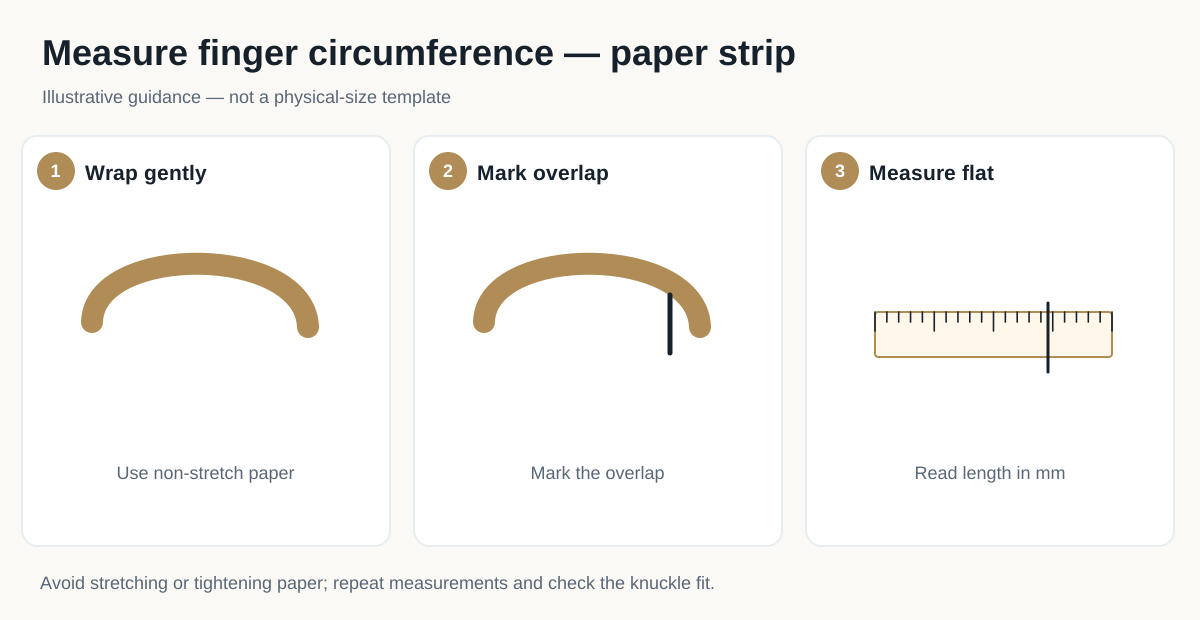
Wrap a thin strip
Wrap a thin, non-stretchy strip of paper snugly around the base of the finger. Mark where it overlaps.
Measure it flat
Lay the strip flat against a ruler and read the length in millimetres. That length is the finger's circumference.
Convert it
Type the circumference into the calculator. Measure in the evening, with warm hands, and repeat twice — ideally on two or three separate evenings, taking the largest reading, since fingers change size day to day.
Mistakes that cause wrong sizes
- Measuring the outside of a ring instead of the inside.
- Using stretchy string or ribbon — it gives a longer, looser reading.
- Measuring cold fingers, or straight after exercise.
- Measuring a different finger, or the same finger on the other hand.
- Ignoring a knuckle that is wider than the finger base — the ring must clear it.
Why you can trust this result
- Calibration uses a standard bank card (85.6 mm wide, ISO/IEC 7810 ID-1) — a physical reference, not a guess about your screen.
- Your measurement is calculated in your browser and is not sent to a server. There is no account and no advertising.
- Results are guidance, not a guarantee. For an expensive or hard-to-resize ring, confirm with a professional fitting.
Frequently asked questions
Related guides
- Measure your ring size
Screen sizer and typed calculator, on one page.
- International ring size chart
Convert any diameter or circumference to US, UK (approx.) and EU.
- Measure ring size without a ruler
Card/coin-calibrated screen sizer, printable sizer, or a ring you own.
- Measuring with swollen fingers
Arthritis and big knuckles: evening measuring, knuckle and base.
- Methodology
How the tool calculates, and what it does not claim.
- Accuracy & limitations
What home measurement can and cannot promise — and when to get a jeweller's fitting.